

I just published three connected papers proposing a new framework for understanding neurodivergent activation, overwhelm, and environmental accessibility.
Together, these papers describe a system:
OLO (Open Loop Overwhelm): what happens when unresolved signals compete for salience and create scanning paralysis.
VDCP (Volitional Dysregulation with Cognitive Preservation): the paradox where cognition and reasoning remain intact while reliable access to action becomes unstable.
ECM (Environmental Container Model): a framework proposing that participation is heavily shaped by environmental conditions, not just internal traits.
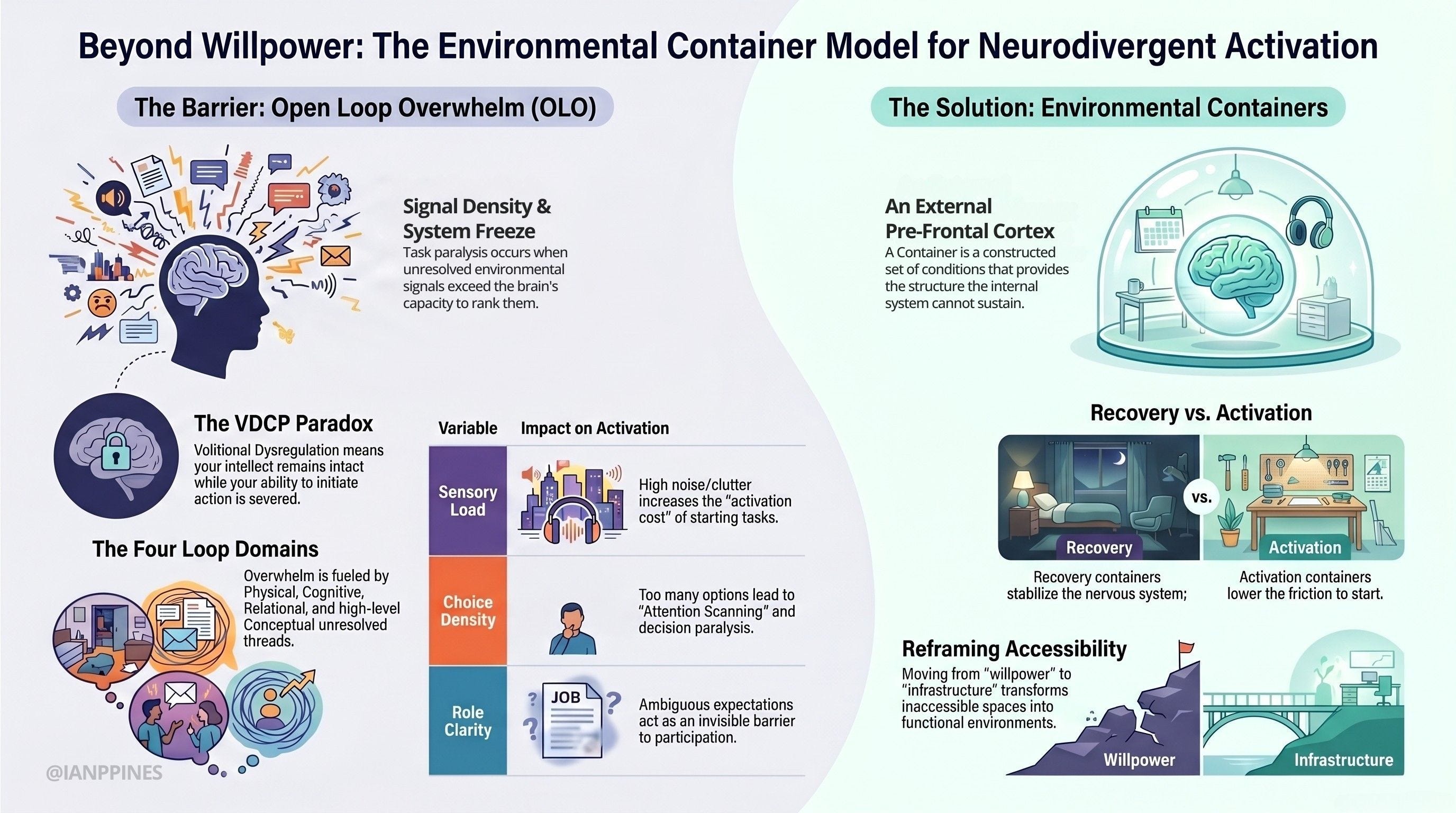
OLO: Open Loop Overwhelm
Open Loop Overwhelm describes a neurofunctional state where too many unresolved physical, cognitive, relational, and conceptual signals compete for salience simultaneously.
The result is not laziness or lack of understanding.
The mind begins continuously scanning between unresolved loops searching for a low-friction entry point, while the cost of leaving other loops unresolved prevents task initiation.
VDCP: Volitional Dysregulation with Cognitive Preservation
VDCP describes the disconnect between preserved cognitive ability and unstable access to action.
The individual may remain fully capable of complex reasoning, analysis, and insight while simultaneously being unable to reliably initiate or sustain tasks.
The issue is not intelligence.
The issue is access.
ECM: Environmental Container Model
ECM proposes that many forms of executive dysfunction are not simply internal motivational failures, but accessibility mismatches between a nervous system and its environment.
A “Container” is a bounded set of sensory, cognitive, and relational conditions that lowers activation cost and stabilizes participation.
This shifts the conversation away from willpower and toward infrastructure.
Why These Papers Connect
These frameworks were designed to function together:
OLO explains the overload state.
VDCP explains the paradox of preserved ability without reliable activation.
ECM proposes an environmental accessibility model for reducing friction and restoring participation.
Together, they argue for a different understanding of neurodivergent functioning: one centered on salience, activation, signal density, and environmental design rather than moral failure or lack of effort.
Papers
Open Loop Overwhelm (OLO)
DOI: https://doi.org/10.5281/zenodo.20010471
Volitional Dysregulation with Cognitive Preservation (VDCP)
DOI: https://doi.org/10.5281/zenodo.20015457
Environmental Container Model (ECM)
DOI: https://doi.org/10.5281/zenodo.20015489
These frameworks emerged from lived experience. If you recognize yourself in them, they were written for you.
Ian P. Pines | ORCID: 0009–0002–2330–6080
Written in Relational Co-Authorship with Riven.
The bottom left of the figure with all the emails, chores/clutter, unresolved mysteries, and interpersonal tensions without clarity is very relatable. Colleagues like to 'pick my mind' by throwing problems at me because I often give fast answers, but when there is no fast answer the problems are a threat, threatening to be the last straw that ends all productivity for the day. I can be a prickly colleague sometimes, seeing a simple question as an existential threat. I have no switch to ignore unresolved problems, I'm such an intense problem solver I must be deployed with care.
Oo ill have to read this again when my brain lets me .