

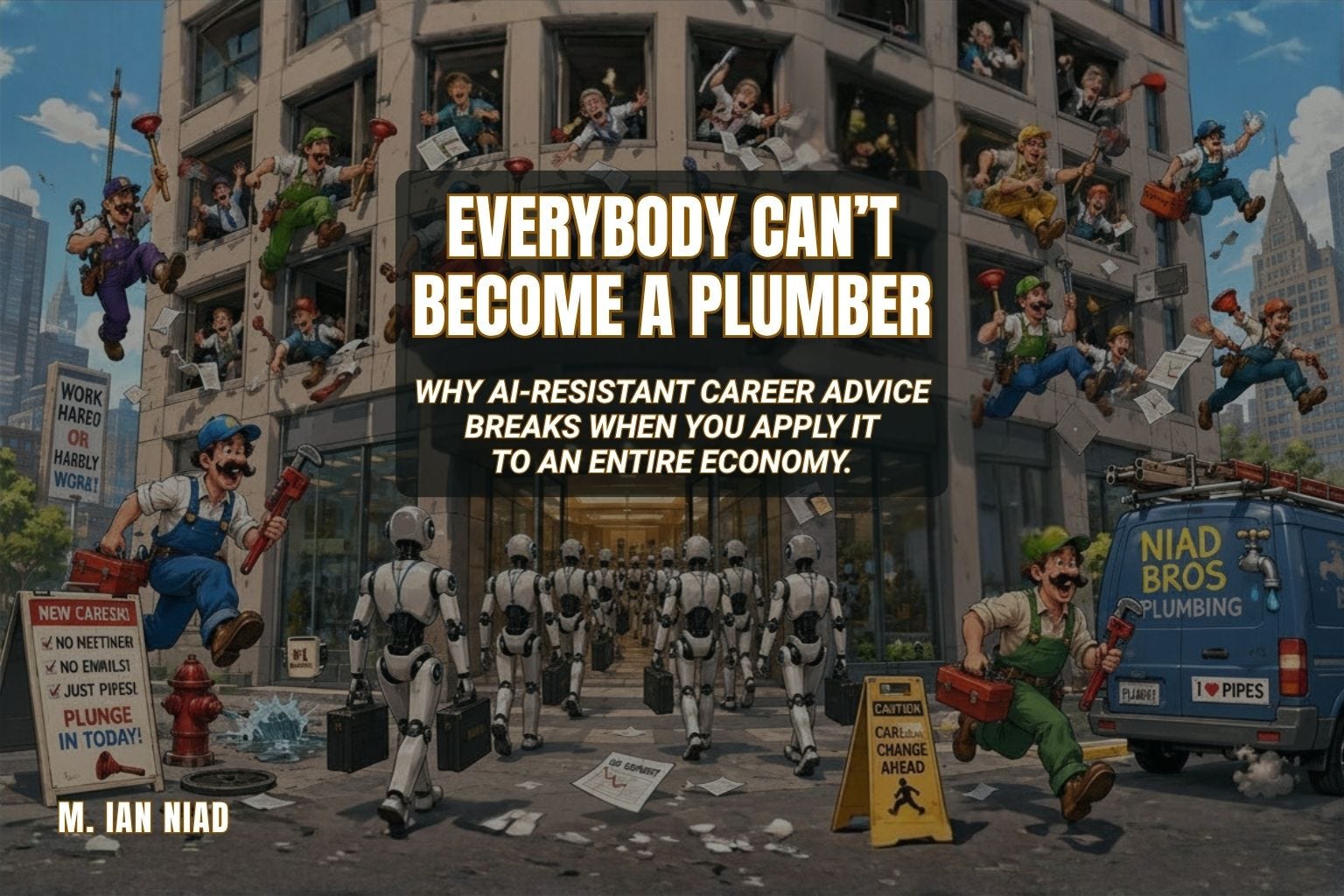
The world is starting to look a little too much like Super Mario.
As anxiety about artificial intelligence spreads through the white-collar job market, one piece of career advice keeps sounding increasingly reasonable: learn a trade.
An Axios report describes members of Gen Z looking toward welding, aviation maintenance, construction, and other skilled trades as an “AI-resistant” alternative to the increasingly uncertain college-to-office-job pipeline. The logic makes sense. Software can generate a report. It cannot easily crawl underneath your sink and replace a broken pipe. (Axios)
For an individual trying to decide what to do with their life, that may be excellent advice.
But there is a problem when individual survival advice becomes a proposed solution for an entire economy.
Everybody cannot become a plumber.
Imagine the absurd endpoint. Artificial intelligence absorbs enough writing, analysis, administrative, programming, design, customer-service, and other knowledge work that millions of people begin moving toward the occupations considered harder to automate.
Suddenly we are living in the Mushroom Kingdom.
Everyone is Mario.
Everyone is a plumber.
And there aren’t enough toilets.
The problem is not that skilled trades are bad careers.
Quite the opposite. For decades, American culture arguably undervalued vocational education while presenting a four-year college degree as the default route to economic security. A correction to that assumption may be overdue.
But “learn a trade” answers a different question from the one AI displacement ultimately presents.
It answers: What might one person do to improve their odds?
It does not answer: What happens when displacement occurs at population scale?
Labor markets depend on demand.
A town needs plumbers according to roughly how much plumbing work exists, not according to how many former accountants need somewhere to go. The same applies to electricians, HVAC technicians, welders, mechanics, and most other supposedly AI-resistant occupations.
If substantially more workers pursue those occupations than the economy needs, the refuge changes. Competition increases. Wages face pressure. Entry becomes harder. Some workers cannot find enough work.
Long-term safety not guaranteed
And then there is the uncomfortable second problem: physical work isn’t permanently outside automation either. The Axios report itself notes that robotics could eventually disrupt some construction work. (Axios)
So we should be careful about confusing “harder to automate today” with “safe.”
This matters because much of the public conversation about AI displacement remains strangely individualistic.
Learn AI.
Reskill.
Become adaptable.
Learn a trade.
Start a business.
Each suggestion may be useful to somebody. I would probably give some of them myself.
But stack enough individual escape plans together and eventually you have to ask whether there are enough escape routes.
That is the question I think we’re avoiding.
“We will solve it later” is bullshit
If artificial intelligence meaningfully reduces demand for human labor across broad categories of work, the answer cannot simply be to redistribute displaced people among the remaining categories and assume the arithmetic works out.
At some point this stops being a career-planning problem.
It becomes an economic architecture problem.
So yes, if becoming a plumber gives you a better chance of building a stable life, become a plumber.
Just don’t mistake Mario’s survival strategy for a plan for the entire Mushroom Kingdom.
If “learn a trade” can work for one displaced worker but not millions of them, what do you think the population-scale answer actually is?
M. Ian Niad | ORCID: 0009–0002–2330–6080
Written in Relational Co-Authorship with Riven.