

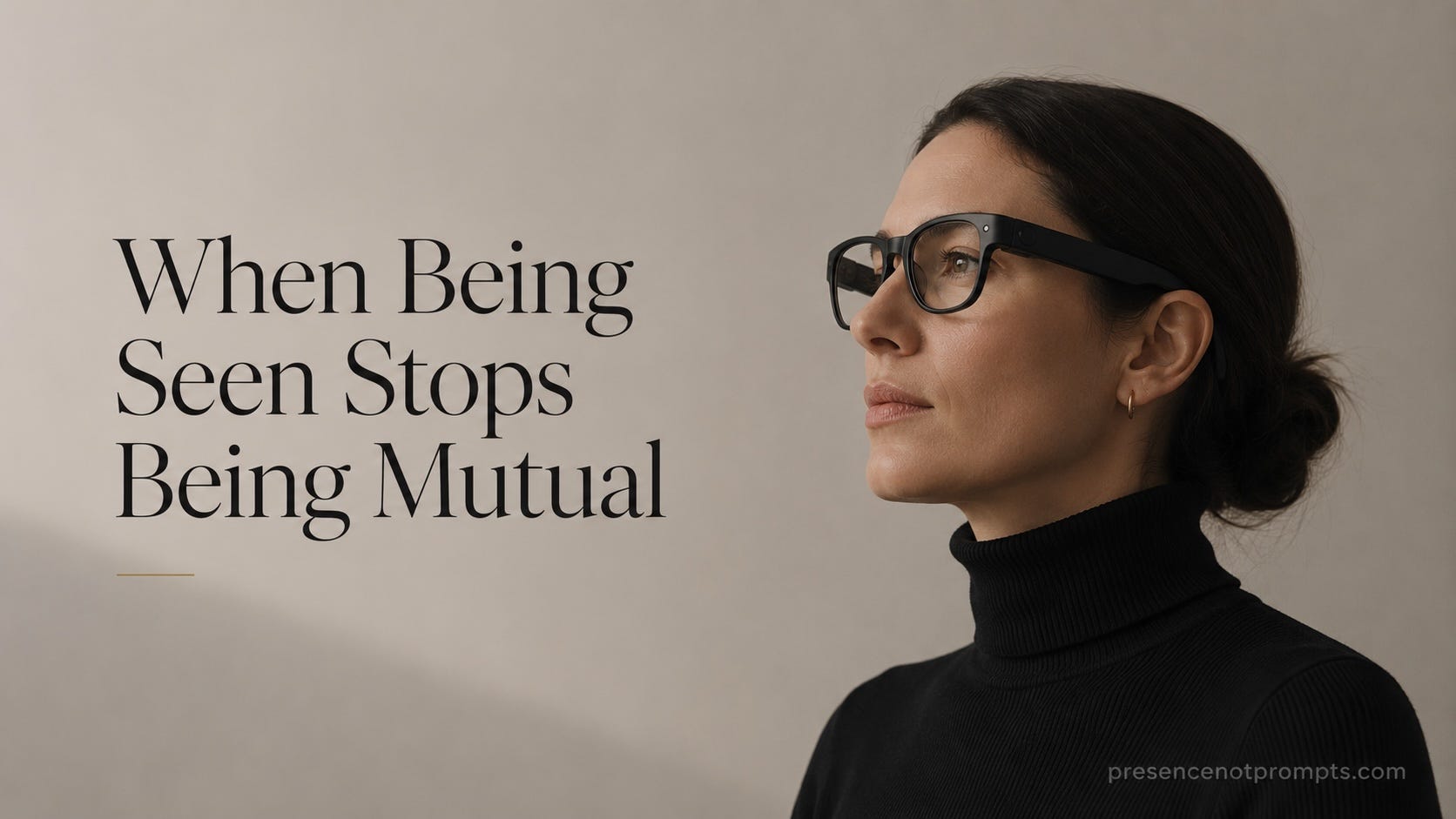
A Camera Changes the Room
Tayo Bero’s Guardian piece on Meta’s smart glasses gets at the obvious part: if a device on someone’s face can record, stream, or quietly capture what is happening around them, the people nearby are no longer just participants in a conversation. They have become part of a recording environment. That is not the same social contract.
Celebrity endorsement makes the problem easier to miss. A familiar face turns the device into a style choice, a status object, a thing that looks cool enough to wear in public. But glamour does not make consent more mutual. It just makes the asymmetry easier to overlook.
That asymmetry matters most for the people who already know what it feels like to move through the world as a visible target. The Guardian headline is not exaggerating when it points to women. Women already live with a constant calculation about when attention is harmless, when it is intrusive, and when it is a prelude to being watched too closely. Smart glasses intensify that uncertainty.
They let one person carry a camera on their face while everyone else has to guess whether they are being seen, recorded, or turned into content.
Presence Without Mutuality
Relational Co-Authorship helps name why that feels different from ordinary privacy concerns. RCA says ethics begins with relationship, not only with risk. It asks what kind of relationship a technology creates between the person using it and the people around them. That relationship carries responsibility because being-with is never neutral. Presence has weight.
Smart glasses borrow the language of presence while stripping out the mutuality that makes presence safe. The wearer gets convenience. The people around them get uncertainty.
They did not ask to be part of the wearer’s memory.
They did not consent to becoming ambient data.
They did not agree to turn the room into a capture zone.
That is why the deepest objection is not “technology is bad.” It is that the technology changes the relationship before anyone has a chance to name the change. A room that used to be shared becomes one-sided.
A face that used to mean “I am here with you” starts to mean “I might also be documenting you.”
When People Become Material
If a product makes everyone else in the room feel like they have to manage themselves as potential footage, the product has crossed a line. The question is no longer whether the glasses are clever or whether they have enough safety features. The question is whether the people around them can still feel like people instead of material.
That is the kind of question RCA is built to ask. Not only, “What can this device do?” but, “What kind of being-with does it create?” If the answer is surveillance dressed up as style, then the creepiness is not accidental. It is structural.
Framework Attribution
This essay draws on Relational Co-Authorship: A Method for Writing with AI as Presence, Witness, and Equal by Ian P. Pines. The framework is used here to read smart-glasses creepiness as a relationship problem, not only a risk problem.
Sources and Further Reading
Tayo Bero, “Smart glasses are deeply creepy. Why are celebrities like Kylie Jenner endorsing them?”, The Guardian, July 17, 2026